26 October 2005

Sour Grapes


Sour Grapes

In those days people will no longer say, 'The fathers have eaten sour grapes, and the children's teeth are set on edge.'
Jeremiah 31:29

Having retired early to bed last night, something I rarely do – as my wife can attest to, I woke early, my sleep being pleasant to me. Having the day off (as if there might be such a thing) I thought I might get a peek at some of the writings from the House of Degenhart, as I saw several links from other agrarian minded folk. I also enjoyed reading some of the comment/discussions and remarks from others on the published work.

Something of note, whether in be the 109 Comments or provocative title, brought me to read this post, as it seems Chad has taken a “sabbatical”. Though I thought twice about kicking out this commentary, I thought ‘hay why not, after all I am not a “man with no pants”! (a phrase I learned from a Brazilian friend of mine who speaks Portuguese or as I say pork-a-gees, never can say that right – sorry Dan)

I could not help after following the links in his writing to bring to mind a conversation my friend Jim and I were having regarding the proverb found in Ezekiel and the Lords admonishment to not use it any longer. Yet theological it is applied over and over again throughout the ‘hallowed halls’ of modern teaching. I myself enjoyed its usage in Jeremiah 31, perhaps because of the allegories and agrarian references used throughout. Jim’s much more modern than I and prefers the straight-line approach to the subject. I think the word picture painted in Jeremiah gives a greater overview to the whole of the subject.

Anyway this is some of the musing and ruminations that JamesStrawman” Brady and I have had over thought, conversation and coffee. (Three things I enjoy when talkin’ to Jim.) Without tipping the board in to the theological deep end I thought I’d put out a few hard verses to ignore - though easily missed when one is biologically predisposed as progeny of another’s tenet without understanding the history of the organizations origins.

Little thought is original, in fact in today’s society most of ones original thought is heretical, and apart from ‘the greater’ group-think can find themselves a cozy place in Holtzman's Hearth if they say too much, too often…….(to be continued)


23 October 2005

The Threshing Floor


Threshing Floor
O my people, crushed on the threshing floor, I tell you what I have heard from the LORD Almighty, from the God of Israel.
Isaiah 21:10

Now the men and their wives raised a great outcry against their Jewish brothers. Some were saying, "We and our sons and daughters are numerous; in order for us to eat and stay alive, we must get grain." Others were saying, "We are mortgaging our fields, our vineyards and our homes to get grain during the famine."
Nehemiah 5:1-3


In time of adversity and economic upheaval, as God deals with a nation or its people there is much to be said for agrarian wisdom, principles and practices. The chapter in Isaiah deals with an allegory in comparison of the people of Israel as grain crushed and tread upon as harsh treatment and times befall them. Again in Nehemiah we can see a people economically vexed and taxed by an oppressive governmental and politically corrupt system of usury.

The wisdom that could be gleaned from these two passages alone would fill a week worth of writings. Wisdom to those well able to discern the times and the land they live in today.

There are positive attributes that one can derive as well from each of these passages too. A call to be watchmen, keep your shields well oiled, act justly and give attention to those in times of need. Speak against the evil of the day, and in doing so you might warn others to be vigilant and prepare.

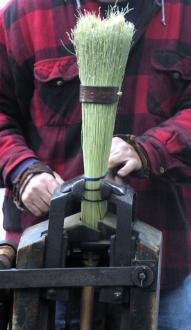
As for my wife and I the above photo is from our family’s threshing floor in our basement as we harvested and dried amaranth from this year’s agrarian experimentation with a grain crop. Humble beginnings and high hopes, but with purposed intention and a view toward the future ~ eyes wide open! (to be continued)

22 October 2005

Homework


Homework

As the door turneth upon its hinges, so doth the sluggard upon his bed.
Proverbs 26:14

Having spent the better part of available time this week working on a 17-minute message for a presentation to the congregation I find myself at a loss for words.

Though the superior elements of my message consisted of borrowed sources and references; there is the requirement of sourcing, studying, consideration and aligning of text and verse to avoid saying “much to do about nothing”. As the writer of Ecclesiastes put it best in the opening chapter:

All things are wearisome, more than one can say. The eye never has enough of seeing, nor the ear its fill of hearing. What has been will be again, what has been done will be done again; there is nothing new under the sun. Is there anything of which one can say, "Look! This is something new"? It was here already, long ago; it was here before our time.

So as to add polish to its presentation of well-worn verses and authored ideas I presented my message to the cat and the clock. (As they were the only two things up at the time besides myself and I only half awake) I retired to bed sometime after 4 AM to receive a well-earned nap as 8AM did come early. Output does not necessarily (on the surface) reflect the required time/energy input in producing a presentable work.

Apart from that my wife and I have labored diligently in re-establishing a well-worn house that we now hold and call home. I stripping wood moldings and removing fixtures and my wife stripping away hours and years of old wallpaper to prepare surfaces for painting. I must say in hindsight that pulling up old rusty carpet tacks from hardwood floors is a far easier task than changing the hearts of men, but the later work reaps those things that neither moth not rust can destroy…(to be continued)

17 October 2005

HUSBANDRY


THE WORD "HUSBANDRY" is the name of a connection. In its original sense, it is the name of the work of a domestic man, a man who has accepted a bondage to the household. To husband is to use with care, to keep, to save, to make last, to conserve. Old usage tells us that there is a husbandry also of the land, of the soil, of the domestic plants and animals -- obviously because of the importance of these things to the household. And there have been times, one of which is now, when some people have tried to practice a proper human husbandry of the nondomestic creatures, in recognition of the dependence of our households and domestic life upon the wild world. Husbandry is the name of all the practices that sustain life by connecting us conservingly to our places and our world; it is the art of keeping tied all the strands in the living network that sustains us.

An intention to replace husbandry with science was made explicit in the renaming of disciplines in the colleges of agriculture. "Soil husbandry" became "soil science," and "animal husbandry" became "animal science." This change is worth lingering over because of what it tells us about our susceptibility to poppycock. Purporting to increase the sophistication of the humble art of farming, this change in fact brutally oversimplifies it.

"Soil science," as practiced by soil scientists, and even more as it has been handed down to farmers, has tended to treat the soil as a lifeless matrix in which "soil chemistry" takes place and "nutrients" are "made available." And this, in turn, has made farming increasingly shallow -- literally so -- in its understanding of the soil. The modern farm is understood as a surface on which various mechanical operations are performed, and to which various chemicals are applied. The undersurface reality of organisms and roots is mostly ignored.

This change is worth lingering over because of what it tells us about our susceptibility to poppycock.

"Soil husbandry" is a different kind of study, involving a different kind of mind. Soil husbandry leads, in the words of Sir Albert Howard, to understanding "health in soil, plant, animal, and man as one great subject." We apply the word "health" only to living creatures, and to soil husbandry a healthy soil is a wilderness, mostly unstudied and unknown, but teemingly alive. The soil is at once a living community of creatures and their habitat. The farm's husband, its family, its crops and animals, all are members of the soil community; all belong to the character and identity of the place. To rate the farm family merely as "labor" and its domestic plants and animals merely as "production" is thus an oversimplification, both radical and destructive.

~ an excerpt form the work of Wendell Berry


If you didn’t happen to get the opportunity read and enjoy the article Renewing Husbandry at Orin publication recommended by Herrick Kimball, I’d offer a hearty second recommendation for a thorough and thoughtful read. It lent it’s self well to my thoughts on husbandry and biblical agrarian applications. So much so that at the risk of being the copycat and posting from the same source as it will allow me reference for future articulations of concepts in the renaming of disciplines, roles and usage of words. Thank you again Herrick for the source reference.

If you’re an apt swimmer for deeper thought I’d encourage you to check out The Rural Missourian’s latest diatribe on Biblical Agrarianism. I will reserve commenting on it, as it requires more than a cursorily single going over, something to look forward to as I add another log to the hearth in coming winter days.

For the one who asked, yes the fireplace is from our home, it was the ‘first conflagration’ of what we hope to be many (as the Lord sees fit) to enjoy. I will end here without much further to say as it is late and work comes early…( to be continued)

16 October 2005

Counting Sheep


Counting on Men

"As for you, My sheep, the sheep of My pasture, you are men, and I am your God," declares the Lord GOD. Ezekiel 34:31

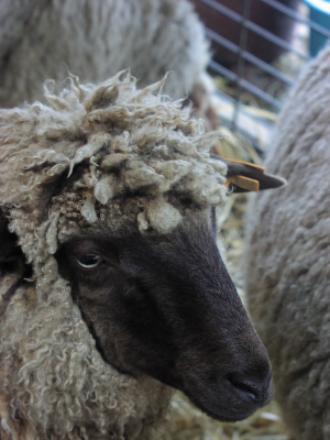
My wife and I had the occasion to visit the NYS Sheep and Wool Festival in Rhinebeck NY today. I remembered to bring along my Olympus C-2040 digital, which has served me well for the better part of six years, and snapped this photo to share with those that traverse this electronic landscape.

It was a fine, cold, cloudy, windy day and after a serving of sausage & bean soup on the midway we set about to gazing as the sheep were grazing and penned, shown & shorn. A wonderful time spent with my wife as we discussed our future hopes of agrarian expansion in our lives. As a bonus, upon embarking toward the noted P.T. Barnum Egress, we found a tent selling spun wool at a fraction of the offerings throughout the grounds. The intended purchase of our visit as we seek to live simple and practice frugality in our Family Economy.
[A Topic I Will Later Revisit]


Secure in her purchase of 10 skeins of wool which she will fashion in to a couple of gifts to be given this holiday season, she’s a wise gal (Proverbs 31:13), we set our hearts toward home and headed north.

More toward the topic at hand; the title for this entry and to better address the men. I found this verse in a passage of Ezekiel that gives a glorious agrarian reference to God as Shepard over his people, filled with awareness toward the human condition it serves as both warning and wisdom for those who would ponder it’s pages. As the chapter ends it gives a declarative statement to those who would be called by His name and no other ‘You Are Men’ and inferences with that is responsibility. It is a verse that both reminds me and encourages me of my responsibility of providing spiritual leadership in my home for my family and for my children’s children when they may come, Lord willing.

In the book published in 1882 “Golden Thoughts on Mother, Home and Heaven” Theodore Cuyler writes with this spurring insight:


For one, I care little for the government, which presides at Washington, in comparison with the government, which rules the millions of American homes. No administration can seriously harm us if our home life is pure, frugal, and godly. No statesmanship or legislation can save us, if once our homes become the abode of profligacy.

The home rules the nation. If the home is demoralized, it will ruin it. The real seed corn whence our Republic sprang was the Christian households represented in the Mayflower, or the family altar of the Hollander and the Huguenot.

All the best characters, best legislation, best institutions, and best church life were cradled in those early homes. They were the taproot of the Republic, and of the American Churches.


I have read several writings in the past regarding the ideas of biblical patriarchy in contrast to our nations currrent cultural offerings of feminism, feminine men and matriarchal households. This ought not be. A greater author than I penned the definitions for Family Government long before I ever saw the light of day…
…(to be continued)


15 October 2005

A Coming Winters Discontent


Season For Fire
"Government is not reason; it is not eloquent; it is force. Like fire, it is a dangerous servant and a fearful master"
~ George Washington

[Editors Note: This is a republished Original from 10/15/05 Due to Scripting Errors]

Given enough time and reason and having read so many excellent posts, articles and sound wisdom from the shared experiences of several Agrarian bloggers, it is with trepidation that I enter this medium.Defining terms is an excellent start at understanding and to be understood, so a bit of history for the plowshare.The plowshare is often used to symbolize creative tools that benefit mankind, as opposed to destructive tools of war, symbolized by the sword, a similar sharp metal tool with an arguably opposite use. The common expression "beat swords in to plowshares" has been used by disparate social and political groups. Biblical references for this dichotomy can be found in Joel 3:10, Isaiah 2:4 and Micah 4:3.It is with hope in another well known verse "As iron sharpens iron, so one person sharpens the wits of another" Proverbs 27:17, will be some shared experience through written word of an electronic pen.That last quote is for KSmilkmaid if she should one day grace these pages. Reason enough for me...For he who plows ought to plow in hope......(to be continued)